As finals week heats up, there may be a shortage of posts-- here's a few to tide you over.
Life in Vladimir Putin's Russia isn't conducive to constitutionally guaranteed freedom of religion. It's under no small thanks to the powerful Russian Orthodox's close (political) relationship with Putin. Below, a story depicts the tough times for Russian Protestants.
Below, I posted a couple of Jill Freedman's 1970s NYC pics. Here's an accompanying video profile of Freedman. She's simultaneously charming and kind of heart- breaking.
Showing posts with label Vladimir Putin. Show all posts
Showing posts with label Vladimir Putin. Show all posts
Wednesday, April 30, 2008
Times Goes East to West


Wednesday, October 17, 2007
Quote of the Day 10/17
"We've got a leader in Iran who has announced that he wants to destroy Israel... So I've told people that, if you're interested in avoiding World War III, it seems like you ought to be interested in preventing them from having the knowledge necessary to make a nuclear weapon."
- President George W. Bush in a strong statement against Iran's ongoing nuclear program. This comes one day after Russian President Vladimir Putin reiterated his country's commitment to helping Iran build a nuclear power plant, and stated that an attack on one Caspian nation is an attack on all Caspian nations.
I feel like I've seen this movie before.
Tuesday, October 2, 2007
Dictatorship in 4 Easy Steps?
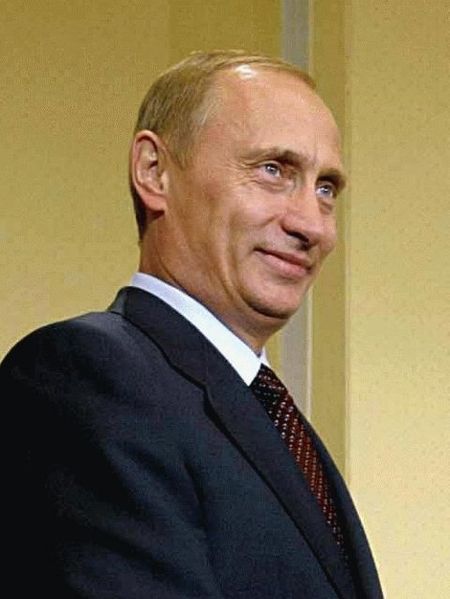
The past few months, a lot of speculation has surrounded Russian President Vladimir Putin. Putin, Russia's second president, is a former KGB agent (and judo enthusiast and Sambo grandmaster) with an authoritarian streak. He has been cracking down on dissent and tightening a grip on the press, in addition to holding a hard line against Chechen separatists, and speaking out against the United States.
In the aftermath of Sept. 11, Putin had a strong relationship with the Bush White House. He was the first foreign head of state to call and offer condolences, and when he visited Bush's home in Crawford, the American President said Putin was a man he could trust.
"I looked the man in the eye. I found him to be very straightforward and trustworthy. We had a very good dialogue. I was able to get a sense of his soul; a man deeply committed to his country and the best interests of his country. And I appreciated so very much the frank dialogue."
However, something changed as Eastern European nations began electing Western-style governments in 2005. Putin resented that the US so publicly backed candidates whom he viewed as his political opponents. At the time, the new governments in the Ukraine and other countries were the potential crowning achievement of the Bush administration. Freedom was on the march, relations with Russia took a backseat.
According to insiders, the experience changed Putin, soured him (or maybe just gave him an excuse). He has talked wistfully of Russia's Cold War power, and about Russia re-emerging to challenge the United States.
In a speech in Germany, he focused on the US trying to establish a "unipolar" world: "...it means one single center of power, one single center of force and one single master... It has nothing in common with democracy because that is the opinion of the majority taking into account the minority opinion... People are always teaching us democracy but the people who teach us democracy don't want to learn it themselves."
So the tension is palpable.
But a funny thing happened on the way to dictatorship.
Russia's Constitution states that the president may only serve 2 four year terms, meaning Putin would be done after Russia's 2008 elections. So Putin had been accumulating all this power, but all the while he maintained he would respect the Constitution and step down after his term, leaving many, myself included, to wonder how this guy was going to hang on to power.
Well, we have our answer.
Here's how he did it:
Step One: Dissolve Government. A few weeks ago, Putin accepted the "resignation" of the Prime Minister, and the rest of his cabinet.
Step Two: Install Puppet. Putin surprised everyone paying attention by appointing Viktor Zubkov, a little-known but well-connected ally as prime minister. Zubkov is a former financial watchdog who worked with Putin during the 90s in St. Petersburg. Translation: He knows who signs his checks. I mean, reports around his appointment said he was "known for his loyalty."
Step Three: Step down from the presidency, right on schedule. We don't want to put the world ill at ease, assure everyone that the Russian democracy is fully functioning. Have your prime minister, your hand-picked successor, take over as president.
Step Four: Have puppet appoint you prime minister. Yesterday, Putin said it's "entirely realistic" that he would seek a post as Prime Minister. Former leaders often run for Parliament after retiring, mainly to attract votes for their party, and serve mostly as figureheads. This seems different, like a new center of power would be created with Putin at its head.
That wasn't so hard, was it?


Subscribe to:
Posts (Atom)