At his confirmation hearings last year, Mukasey's position was that he did not believe water-boarding constituted torture, and would not prosecute those that authorized or implemented the practice against terror suspects.
The group believes that his position leaves him at odds with the University's Jesuit commitment to human rights.
Mukasey will not receive the law school's highest honor, the Founder's Medal, although Dean John Garvey said that decision predated the controversy. The Founder's Medal is given to those who "embody the traditions of professionalism, scholarship, and service which the Law School seeks to instill in its students."
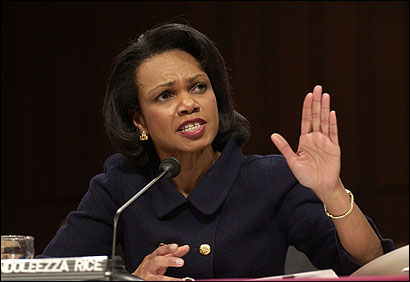
This is similar to the uproar that surrounded Condoleezza Rice's commencement address to the undergraduate class of 2006 (of which SAM blogger CPC is a member). Many students turned their backs, and one professor even resigned.
As a donor to the university (I gave $15 just before graduating), my take is that, based on the criteria, Mukasey probably doesn't deserve the Founder's Medal, but the protest itself goes against the Jesuit principles of reflection and open discussion as much as Mukasey's position.
Debate on serious legal issues is what higher education is all about. As Garvey put it:
"It is a mark of prestige among elite schools to attract a speaker who operates at the epicenter of American legal issues, regardless of whether the speaker's political views are liberal, moderate, or conservative... Far from wishing the controversy would go away, I think we should rejoice in it."
Thursday, March 27, 2008
Mukasey Controversy at BC Law


Monday, September 3, 2007
Quote of the Day 9/3
"She was one of the weakest national security advisors in US history. Her inexperience and her mistakes in that job have shaped the world and colored the choices she must handle as secretary of state... The invasion of Iraq, the missed opportunity with Iran, the breach in relations with Europe, the Arab anger at a perceived bias against the Palestinians -- all of these problems were the direct result of decisions she helped make in the White House. Now, as secretary of state, she tried mightily -- and with limited success -- to unravel the Gordian knots she tied in George W. Bush's first term."
- From The Confidante, a new book by Gordon Kessler of the Washington Post, about former National Security Advisor and current Secretary of State Condoleezza Rice. Kessler spent years researching this anticipated book, which is due out next week. Kessler regularly travels with the Secretary on trips around the world, and interviewed her and others from the Justice Department for The Confidante.
The Associated Foreign Press reports:
The foreign policy failures under Rice's watch include the Israel-Hezbollah war in Lebanon in mid-2006, which "may have marked an ominous turning point -- the decline of American power in the region," Kessler writes.
The author also points to North Korea's nuclear tests in October 2006, which he says the Bush administration could have avoided, and the long stalled Israeli-Palestinian peace process.
Rice has also never been personally engaged in efforts to end the humanitarian tragedy in Sudan's war-torn region of Darfur, Kessler writes.
One of her few bright spots is the US nuclear deal with India, which was negotiated soon after she took the job and still needs to be finalized.
For his book, Kessler, who often travels with Rice on her trips around the world, interviewed Rice several State Department officials, giving him new insight into negotiations between Rice and foreign leaders as as well as her private talks with Bush.
The secretary of state is very secretive about her personal life, but Kessler was able to catch a glimpse of the non-official Rice, learning about how she helped a friend in a financial pinch.
"I think I tried to be relatively balanced," Kessler told AFP. "I tried to be very clear minded."
Kessler is not yet ready to write off Rice, who plans to remain on the job until the end of the Bush presidency, as a failure.
"It is too early to make that kind of judgment," Kessler said. "At the moment though, it does not look very good."