Showing posts with label democrats. Show all posts

Monday, November 5, 2012

"Tomorrow"


Four years ago I did a pretty decent job of predicting Election Night. This time around, my guess is pretty much a reflection of Nate Silver's FiveThirtyEight website. I don't think Obama/ Biden will pull out Florida or North Carolina, but they'll get every other swing state and win with 303 electoral votes.

How I see it

Here's how you know President Obama is headed to victory:


  • Desperate Attacks in Ohio: The Romney campaign has steadfastly maintained it would "not be dictated by fact-checkers." Never was this more apparent than in its ads that claimed the auto-industry bailout would lead to Chrysler shipping jobs to China. But in a campaign full of half truths and outright lies, that was a bridge too far. Chrysler called them out, and the claims failed to dent Obama's consistent lead. It seems to me this attack was a last-ditch desperate attempt to swing Ohio. If Romney thought he was ahead there, his campaign wouldn't need to resort to such tactics.
  • Romney tries to open Pennsylvania: Romney spent parts of the week before the election campaigning in Pennsylvania. The Romney campaign claimed it was expanding the map and laying the groundwork for a landslide. Nonsense. Romney campaigned there for the same reason he ran the Chrysler ads, he knew he wasn't going to win Ohio. McCain did the same thing four years ago, making a late and ultimately unsuccessful play for Pennsylvania. Seeing Romney bound around the Keystone state tells me his advisors can read polls better than many of their supporters, who are hellbent on discrediting Silver's math. But if you can't win Ohio, which normally leans Republican, you ain't winning Pennsylvania, which leans Democrat.
Nate knows. And, really, Mitt does, too.
  • Emphasis on tiny states: I actually live in a battleground state media market, New Hampshire. This is just anecdotal evidence, but it seems to me Romney is advertising here far more than Obama. Once again, this tells me that Obama realizes his campaign is 1) ahead NH in polls, and 2) safe electorally without New Hampshire. Romney's appeal for New Hampshire's four electoral votes indicates how desperate he is to patch together 270.
  • Threw up in my mouth a little: Last night I watched 60 Minutes which aired a truly disgusting segment on the broken mess that is the U.S. Senate. It was the typical "Both parties are partisan and don't want to get things done!" B.S. that has made shows like 60 Minutes largely irrelevant. The most odious part was watching Tom Coburn, the ultra-conservative senator, say that the Senate is so lacking in leadership that it is better off broken than functioning. Of course no one called him on his crap, but it's a perfect example of why the Right will always triumph in our system: Conrad and his conservative colleagues WANT that disfunction. Steve Kroft, or whichever dinosaur was interviewing Conrad, kept saying that the American people want the parties to come together to solve problems. But he never mentioned that Republicans do not believe the government should solve problems. They do not believe in government. They joined it to destroy it. So when Conrad tells his constituents the Senate is better off not functioning, he wins. That incentive system is what has destroyed the U.S. Congress.
  • Gross consequences: This messed up system is what allows Mitt Romney and Paul Ryan (!) to tell people to vote with them because they'll be able to deal with Congress. Think of the cynicism. The Congressional Republicans publicly stated their top goal, with the economy in shambles, was to make Barack Obama a one-term president. They fought him at every step to block his agenda. Now, when Romney says he will be able to get things done the implication is clear: We know that if the president wins the Republicans won't let him do anything, so vote for me and since I'm pushing their agenda and we control the House, and Democrats believe in government action, we'll be able to do something. Either reward our terrible behavior or suffer more of it.
  • More awful incentives: A similar incentive system has destroyed U.S. elections. People hate how incessant political campaigning has become and, more than anything, how negative it is. That, too, plays into Republicans' destructive hands. The constant negative campaigning can depress turnout, which helps Republicans. So Republicans go ultra negative, and Democrats (knowing they cannot stay silent) respond with equally negative messages, causing many to tune out and drop out of the process. Again, a win for the conservative movement. Democrats rely on people participating, but Republicans have an incentive to be as negative as possible.
  • Excuses excuses: Just like revisionist historians have credited the financial crisis with Obama's big victory in 2008, expect similar Republican handwringing about Hurricane Sandy. But the fact is Romney's momentum stopped before the storm, and the race is now where has always been, save three weeks between the DNC and the first debate: Obama with a small but solid lead.
  • A battle for the soul of the Republican party will begin on Wednesday, as establishment Republicans seek to wrest their party back from the Koch brothers/ Tea Party wing of ultra conservatism. The team captains already seem to be staking out their ground, with Governor Chris Christie on one end and Congressman Paul Ryan on the other. Because of the primary system, Ryan's scorched earth orthodoxy will likely win out. That is ultimately bad for Republicans, good for Democrats, and terrible for the country.
On that sunny note, I'll wrap this up. Enjoy the returns. And the weeks of Republicans shouting about how the election was stolen (unless Obama loses, in which case it likely was stolen).

Tuesday, October 2, 2012

Republicans Have a Big Problem And It Ain't Mitt

There is a dirty little secret festering beneath the surface of Governor Mitt Romney's presidential campaign. What started as whispers by the Republican establishment has grown into a murmur, and will likely be heard as a dull roar when President Obama takes his next oath of office in January. The secret is the plain and, for Republicans, painful truth that theirs is no longer a national party.

The Republican party's candidate for president has won the popular vote only once in the last five elections. If President Obama's current lead holds, that will be one win, George W. Bush's squeaker in 2004, in twenty- four years.

As America's demographics continue to shift toward people of color, the Republican message of deregulation and tax cuts will grow more stale and ineffective. Those policies have failed to help middle-  and lower- class families for 30- plus years, but until this decade, Republicans were able to attract those voters and win national elections through social issues. More than just raising wedge issues like abortion or gay marriage, Republicans would often talk about societal decline in racial overtones. Whether it was Ronald Reagan's anonymous welfare queen or George H.W. Bush's Willie Horton ad, Republicans gleefully ostracized minority voters.

But a funny thing happened on the way to Karl Rove's permanent majority.


The country got less white, and it gets less so every year. Working class whites have an interest in the status quo, and can be called "conservative" in the true sense of the word. This group often resents what they see as government intrusion through policies of affirmative action or welfare. Meanwhile, immigrants look to the government to provide a fair system and safety-net as they work to establish themselves. Meaning Ronald Reagan's base is shrinking as Barack Obama's grows.

Furthermore, society's evolving positions (to borrow a phrase) on issues like gay marriage and immigration, have taken once powerful weapons of mobilization out of the Republican arsenal.

So, Republican orthodoxy of tax- cuts and deregulation increasingly has to stand on its own, without social issues and under-the-table prejudice to help win the day.

And the results have not been pretty for Republicans.

Take this summer's nominating conventions, each a chance for the parties to convince the American people of its vision for government. The Republican convention came and went without a ripple, let alone a splash. Meanwhile, Democrats are still riding a wave of support generated by their prime-time speakers. The success of one convention and failure of another was not about Bill Clinton's eloquence or Clint Eastwood's nonsense. Democrats are just selling a product that more voters want to buy.

Make no mistake, the polls in this election will continue to be tight, and the Republican strategy can still work when their side is far more motivated to vote. But that isn't easy to pull off in presidential politics. And thanks to that shift in demographics and increased Republican extremism, there are flat out more people who identify and believe in the Democratic vision than the Republican.

This is something the Romney camp seems to recognize, and since tabbing Ayn Rand in shirt sleeves for vice president, the campaign it has made a hard turn to the center. That includes ads where Romney implores voters that he cares about working people just as much as the President does, and an interview in which he praised parts of Obamacare. His campaign realizes that if only 2006 Governor Romney were running, he'd have a real shot.

As First Read and Politico reported, Republicans have begun to lay the blame for a disappointing campaign on Romney himself, asserting that he did not present the clear case for conservatism. Among them, Governor Chris Christie, eagerly awaiting his 2016 run for the White House, told Meet the Press that Wednesday's debate would turn the election because Romney would  go head-to-head against the president with a message of conservatism. The implication was clear: if the campaign continues to falter it isn't about the opportunity or the message, it's the messenger.

Republicans hope that repeating this lie enough might somehow make it true. But deep down theirs is an inconvenient truth: that in order to reclaim its status as a national party, the Republican party must come to grips with a changed nation. If they don't, they'll look back on this election not as a disappointment, but on the closest they came to the presidency in a generation.

Monday, November 17, 2008

Quote of the Day 11/17

Bob Hope delivers this classic one- liner in 1940's The Ghost Breakers.

Tuesday, November 4, 2008

Thoughts and Predictions for Tonight

Here are some thoughts and predictions on the eve of the election:


  • Barack Obama will win big, 364- 174. The swing states he'll carry will be Colorado, Florida, Missouri, Nevada, New Hampshire, New Mexico, North Carolina, Ohio, Pennsylvania and Virginia. McCain will carry Indiana, Montana and North Dakota.


  • Southern Florida reminds me a lot of South Bend, Indiana with better weather.


  • The Democrats will fall a seat shy of a 60- seat filibuster proof majority.


  • The people of Florida have showed uncommon patience, waiting up to four hours to vote early, with lines wrapped around the block.


  • After Tuesday night, Sarah Palin will mercifully recede from public view for a few months. Soon, though, we'll start to read the inevitable stories of her listening tour or some major speech that she's giving in Iowa or New Hampshire.


  • The words of congratulations and thanks that Barack Obama gives President Bush during his Inauguration on January 20, 2009 will be one for the Awkward Moments Record book.


  • I wish there was a way to see the look on Sean Hannity's face when Chief Justice Roberts gives Obama the Oath of Office ("I Barack Hussein Obama do solemnly swear...")

  • Obama will need to hit the ground running with his legislative agenda, because he'll almost certainly lose seats in 2010. But let's not think about that right now, and just enjoy tonight...


Thursday, August 28, 2008

Getting Nervous

In the interest of full disclosure, I did not watch all of last night's convention coverage. With the Mets in the fight of their lives, I had to flip back and forth. But I doubt that made any difference on my opinion, and I've since gone back and read or watched the speeches...

I am officially worried.

This entire summer, I predicted a blow-out. I guaranteed Barack Obama would shatter 300 electoral votes, sweep an impressive majority into Congress, and wield the "political capital" President Bush so pompously claimed in 2004.

But now, I'm worried about my party's November chances.

This week, Democrats haven't driven the final nail into the Bush Administration's coffin, or fortified their position as the stronger party for the next generation. They've only taken us half way.

All week in Denver, primetime speakers have stated the obvious: We cannot afford four more years of Bush policies. The American dream now seems out of reach. Barack Obama can change the direction of the country.

So while the speeches were good, and each major speaker accomplished the goal handed down by the 24- hour news media, there was very little overall connection to the overarching theme of why our country is so desperate for change. Instead they answered GOP talking points: what is Barack's story? does Michelle love her country? will Dems unite?

The speakers offered up worn phrases mixed with the most tired of political devices-- the encounter story. You know what I'm talking about:

"Once I met a woman with one leg, no house and the Clap..."

"... that's when I met Joe, who works 8 jobs, sleeps a half hour a month, and makes just $12k/ year..."

"An old Army vet told me the only thing he loves more than the American flag is apple pie, and the only thing he loves more than apple pie is a bald eagle carrying the American flag in his talons, and the only thing he loves more than that is if the eagle served him a heaping slice of apple pie in the Grand Canyon..."

(Is it just me, or is that stuff is entirely ineffective? I find it forced and disingenuous. And even if those encounters really happened, Democrats need to speak to the middle class, not the guy with no legs and VD.)

What was entirely lacking was meat to back up the words. When President Clinton was in office, his speeches were littered with statistics that illustrated our country's progress. Wow, you'd think, we're doing really well. He did some of that last night, but in all there was not nearly enough.

The only hard facts or numbers that stick out from this week is the price of gas, which we already knew, and may not even be a political winner thanks to confusion over the (lack of) benefits to drilling.

Of the four major speakers (Michelle Obama, Hillary Clinton, Bill Clinton and Joe Biden), President Clinton had the best appeal to average folks:

"In this decade, American workers have consistently given us rising productivity. That means, year after year, they work harder and produce more.

Now, what did they get in return? Declining wages, less than one-fourth as many new jobs as in the previous eight years, smaller health care and pension benefits, rising poverty, and the biggest increase in income inequality since the 1920s...

They took us from record surpluses to an exploding debt; from over 22 million new jobs to just 5 million; from increasing working families' incomes to nearly $7,500 a year to a decline of more than $2,000 a year; from almost 8 million Americans lifted out of poverty to more than 5.5 million driven into poverty; and millions more losing their health insurance.

Now, in spite of all this evidence, their candidate is actually promising more of the same."

That is what we needed, but we didn't get enough. In making their closing argument, Democrats asked for the verdict without presenting the evidence.

In the minds of too many Americans, that comes across as America- bashing. Democrats have the charge of any party out of power, speak to the virtue of the country and enrage the electorate that its been so badly mismanaged. It's an awkward task made easier because this administration's mismanagement has been so blatant. But Dems didn't remind the public why we're so passionate this time around. The focus was on shorting out Republican attacks instead of building our case against the other side.

Two oil men took over the government and ran up record oil profits. Along the way they tanked the economy, re-wrote the Constitution and put unqualified friends in positions of public trust. Millions have suffered because of their incompetence-- that is this president's legacy. But Democrats shied away from addressing it explicitly, favoring general language instead.

It could just be the lawyer in me, or the Carville- influence. Maybe I'm just more into the pointed style. But as I watched the speeches, I had to remind myself why I don't like this president or the Republican party; why I believe the country is on the wrong track. Those are memories and connections I shouldn't have to make, the Democrats should be walking voters slowly down memory lane of the last eight years.

Maybe Obama pulls it off tonight. Maybe it won't even matter. Maybe I'm just being paranoid. Maybe, but I'm officially worried.

I'd be remiss if I didn't mention John Kerry's solid speech on John McCain and international relations:

Monday, August 25, 2008

8 Short Years

Much has been made, and rightly so, of Barack Obama's meteoric rise in Democratic politics. We all know where he was at the last Democratic National Convention in Boston, delivering a stirring keynote address as a Senate candidate.

But few know where he was at the convention before that, the 2000 DNC in Los Angeles. Today, I heard a reporter from the New Yorker detail Obama's 2000 convention experience on NPR. It's a time he's called a low point in his life.

Back in the summer of 2000, Barack Obama was a failed Congressional candidate. He'd run against incumbent and former Black Panther Bobby Rush, and was soundly defeated-- 62%- 31%-- in the Democratic primary.

His marriage to wife Michelle was also on the rocks. She hadn't wanted him to run in the first place, they were short on money and looking to expand their family.

After his trouncing, Obama seriously considered giving up on politics. He asked friends for advice, and they suggested he fly out to LA and try to network at the Democratic National Convention. Short on money, Obama found a cheap ticket on Southwest and headed to LA with big dreams.

But like so many others who make that trip, things didn't go as planned. When he landed he tried to rent a car, but his credit card was rejected. After hours of pleading and negotiating he was given a break-- they took a check. He showed up at the Staples Center, but couldn't gain the credentials to get in.

So he stood outside, waiting to recognize someone who would bring him inside. Meanwhile, most of the very people who will nominate him for president this week celebrated. He was 39 years old, and his political future looked uncertain at best.

But Obama didn't give up. He held onto his seat in the Illinois Senate, and won the primary to succeed retiring Sen. Peter Fitzgerald in 2004. Locked in a tight battle with investment banker Republican Jack Ryan, Obama was tapped to deliver the keynote address of the event he was shut out of just four years earlier. When scandal engulfed the Ryan campaign, Obama had a cakewalk in his November election, garnering 70% of the vote.

This time around, after dismantling the greatest Democratic political machine in a generation, Barack Obama won't need credentials to get into the DNC.

And I'm guessing that his rent-a-car will be long, black and paid for.

Wednesday, May 14, 2008

One Special Election

Recently, Democrats captured two staunchly conservative Congressional districts in special elections. One was the Louisiana 6th, which Republicans controlled for over 30 years. The other (Speaker Hassert's old seat in Illinois) was held by Republicans for 76 years, save one 2- year term after Watergate.

Now, chalk up another one.

Last night, Democrats won Mississippi's first Congressional district, which President Bush carried with 62% in 2004. A Democratic Congressional candidate hadn't broken 35% in more than 15 years. Congressman- elect Travis Childers (D- MS*) narrowly defeated Southhaven Mayor Greg Davis.

The writing is on the wall- 2008 could be a re-aligning election. Democrats can win in places they haven't since LBJ, if they continue to focus on middle class issues (more on this later) and run with the change theme.

However, with such potential comes immense expectations from loyalists and donors. That pressure falls on Democratic leaders like Howard Dean, Rahm Emmanuel, Chuck Schumer, Nancy Pelosi, Harry Reid and (of course, most of all) Barack Obama.

*- How weird does that look? It's like something out of 1954...

Quote of the Day 5/14

The bottom line is this: the White House is won in the swing states, and I am winning in the swing states... The question is: why do so many people keep voting? Why did 64% of Democrats say in a recent poll say they wanted this race to continue?
- Sen. Hillary Clinton after her huge 67- 26% victory in West Virginia.

Senator Clinton won the primary in Ohio, which decided the 2004 election, Florida (though Sen. Obama didn't campaign there), which decided 2000, and now West Virginia, which no Democrat has won the White House without since Woodrow Wilson in 1916.

The White House is indeed won in the swing states, that's what makes them swing states. The question that underlies Sen. Clinton's bottom line is: what are this year's swing states?

If the Democrats need West Virginia this time around, Sen. McCain can probably start measuring the Oval Office drapes now.

But Obama has beaten Clinton in Republican- leaning states that he could win November: Virginia, Colorado, New Mexico and Missouri among others. If Obama won a couple of these, West Virginia and other more traditional swing states might not matter.

Wednesday, May 7, 2008

Obama puts it away

Last night, Hillary won the great state of Indiana. Maybe it was Monday's stop at the Dairy Queen down the corner from my house that put her over the top. But it was only by two points, 51- 49. And she's skipping the morning talk shows.

So basically, after his 14- point victory in North Carolina, the Democrats have their nominee. It's no longer a question of who, it's a matter of when.

Below is Obama's NC victory speech. Complete with his newly developed southern accent!

Delegate Update

NBC News has allocated some of the pledged delegates from Indiana and Pennsylvania.

INDIANA: Clinton 35-31 (6 remain to be allocated)
NORTH CAROLINA: Obama 49-42 (24 remain to be allocated)

The Delegate Counts:
PLEDGED: Obama 1,572-1,415
SUPERDELEGATES: Clinton 272.5-256
OVERALL: 1,828-1.687.5

This would put Obama within 197 of the 2,025. (This, of course, does not include Florida and Michigan.)

NOTE: For those tracking popular vote and that metric at home, Obama has likely netted more of the popular vote out of North Carolina than Clinton did in Pennsylvania. With 98% reporting in North Carolina, Obama leads by 225,266 votes. Clinton netted 214,224 out of Pennsylvania.

Thursday, April 24, 2008

There's Bad, then There's Baaaad

Running for President of the United States (or POTUS, for those "in the know") opens all kinds of doors, especially for the losers. Whether Senators Hillary Clinton or Barack Obama win the nomination, the loser will have a rich future. Leadership opportunities within the Congress and party, private sector positions from board seats on up, and probably even a free gig writing for, oh say, Newsweek, every 2-3 weeks (just to let us know (s)he's alive), among many other prominent opportunities. Mrs. Clinton will probably lose the nomination, which means Senator Harry Reid of Nevada should seriously fear his Majority Leader status. And, if by some profoundly racist maneuver, the Democratic party dismisses Mr. Obama, well, in the words of Nas "the world is yours."

Losing a primary contest, especially after making huge headway, is a feat only a fortunate few experience. Unfortunately, sometimes imbeciles do pretty well in elections, and they, too, are privy to the luxuries of losing. Some losers, no matter how unfit, can even become party chair. People, I'm speaking of DNC head, former governor of Vermont (where Killington rules!!!), and a man who, at one point, was the leader in the '03-04 primary. Howard Dean, America. Howard effing Dean.

In the wake of the Democratic party's '04 Bull Run, with the defeat of Senator John Kerry, and dozens of Rep's in the House and Senate (particularly then Minority Leader Senator Tom Daschle), Dean was elected its chairman. Forget that his brand of liberalism was as unpopular then as in any other time in modern history. Forget that he showed an inability to run a national enterprise under positive circumstances (i.e. his campaign in early December 2003), let alone the dismal times the DNC was in. Forget that his opponents were Donna Brazile, a party strategist who knows her stuff, and Tim Roemer, former Indiana Congressman and 9/11 Commission member. Despite a prairie full of obstacles, Dean was elected party chair.

The consequence was seen in the '06 midterm elections. With several upsets brewing in traditional Republican districts, and Democrats poised to take back key moderate ones, Dean was slow to release DNC money to help push the results over the edge. In many cases, he simply never got money to some campaigns. Former Clinton strategists James Carville and Paul Begala blamed Dean for the party's failure to take dozens of additional seats. They openly questioned his ability to run the party effectively, and considered him a dreadful mistake.

Now, we're at a moment where neither Mrs. Clinton nor Mr. Obama seem poised to drop out. Mrs. Clinton's nomination might seem impossible to attain, yet calls for her to drop out are wrong. She's won Texas, Ohio, Pennsylvania, California, Massachusetts, and then some. Would you drop out, with the kind of following she has, with those victories under your belt? I wouldn't. Mr. Obama, meanwhile, is in the lead. Say what you want about his obstacles, he's in the lead.

Reverand Wright and "Bitter"?

He's in the lead.

Black and middle name Hussein?

Lead!

In these moments, tough standards need to be applied. Speaker Nancy Pelosi tried to create one standard by suggesting Super-delegates support the candidate with the most delegates. Of course, the Clinton machine quickly put her in her place, essentially undermining the first female Speaker's position in her party... how ironic.

As party leader, Howard Dean should have seen this problem from the jump. When it was clear Mr. Obama was going nowhere by mid-February, he should have set the standards as to what constitutes victory. Whether it would have been like Pelosi's or not, it's important to have an end- game. As party leader, he should have dealt decisively with Florida and Michigan, which are now albatrosses for the party. Mrs. Clinton now claims those delegates although Mr. Obama, obeying party rules, didn't even campaign there. Mrs. Clinton's claims on the states, despite party rules, only further confounds the process. Simply saying that things must be settled by July won't make it so.

Of course, Dean can't be blamed for the closeness of the primary. But his incompetence and ineptitude does nothing to bring it to an end. Rather, his mere presence (or lack there of) seems to embolden the Clintons, and makes Obama hope for his quick resignation from the party, or the planet.

Either will do.

Monday, April 21, 2008

Closing Messages

Clinton's closing PA ad:


Obama's campaign responded by citing this 2004 speech from President Bill Clinton, who made a compelling argument interpreted in its favor.

PA Preview: Bowlers and Gun- Owners

NBC News provides an first glance at what to expect during tomorrow's Democratic Pennsylvania Primary:

A new MSNBC/McClatchy/Pittsburgh Post-Gazette poll suggests things are staying fairly competitive in Pennsylvania. This survey of 625 likely Dem primary voters was conducted Thursday and Friday, and it shows Clinton leading Obama by five points, 48%-43%. So what happens on Tuesday? Looking inside the poll's demographics, the highest undecided totals are in the more rural parts of the state -- and that's not good news for Obama. In the so-called "T" region of the state (almost everything between Philly and Pittsburgh), Clinton leads 51%-37% with 11% undecided; this is one of the few demographic groups sporting double-digit undecided. Two other interesting crosstabs with high undecideds also signal the potential that the undecided vote will break for Clinton. Among bowlers (24% of the electorate) and gun owners (38% of the electorate), Clinton leads big among these cultural conservatives: She's up 54%-33% among bowlers and 53%-28% among gun owners. So while the poll shows Clinton with a narrow -- and arguably narrowing -- lead, the clues inside the numbers indicate this is her race to lose and that her lead could expand.

*** Will it be five points or more? Should tomorrow’s primary end up as close as this poll suggests (i.e., five points or less), then this means many of these undecided potential Clinton voters decided to stay home. If they come to the polls, she could see her lead climb to more than five points. And this seems to be why Obama has gone negative in the past couple of days: to keep these undecideds away. He might have also sharpened his tone a bit to beat back the growing post-debate perception that he was looking weak. After all, the undecided voter in Pennsylvania looks to be the type of voter that wants to see a strong walkin' and talkin' candidate. So here’s the game on Tuesday -- it’s not if Clinton will win, but how big will her victory be. She'd like to net more than 200,000 in the popular vote, which she would only get with both a large turnout (approximately 2 million total) and a 10-point-plus victory.

Wednesday, April 9, 2008

Turning Points

Roger Simon, of Politico, wrote a very interesting piece asking "Where did the tables turn?" for Hillary Clinton's campaign. How did she go from "inevitable" to campaign life- support?

Simon points to her loss in Iowa, where it's questionable if she should've campaigned in the first place, as the moment when Hillary's campaign got away. They underestimated the power of younger voters, and overestimated their own organization.

Somehow, they lost Iowa, Simon says, and allowed a well- financed and talented candidate in Barack Obama to start his foray into national politics with a running start.

But, I would argue that she began her downward spiral earlier, at the Halloween debate with her now- infamous response to a question on NY state's plan to give driver's licenses to illegal immigrants. She stammered and failed twice to give a clear response, saying she understood and sympathized with the problem and the plan, but did not fully support it.

Even her husband said it was a bad answer.

Before that, she'd been running a near perfect campaign. But that opened the door, confirming for many their greatest suspicion about her-- that she'd say anything to get elected, and would duck important issues in the process.

In retrospect, there were factors beyond her control: John Edwards' popularity in the state, and the huge turnout of young voters. But that question... it was so revealing. That was the moment I decided I couldn't vote for her in the primary, and I don't think I was alone.

Up to that point, Edwards and Obama were each jockeying to be the alternative to Hillary, but it didn't seem like the Democrats wanted or needed one. They were on board with the whole inevitability thing, but that question raised doubts:

We're about to anoint this woman our nominee, but she can't even talk straight. Let's shop around.

Soon, she'd lost her lead in Iowa, and although she rebounded in New Hampshire, things were never the same. Millions of Democrats across the country had looked elsewhere and found something, someone they could believe in.

In the end, the inevitability that marked the early part of Clinton's campaign was her greatest strength, but led to her downfall. The only way she could beat out a more politically talented opponent was to never let him get on his feet. And the only way to do that was to stay perfect. Once she lost perfection, she lost the race.


In another debate some three months later, Democrats were asked if they could have one response back from all the questions they'd been asked in debates thus far, what it'd be. The crowd laughed and the camera panned to Hillary. She smiled knowingly and put on a brave face, giving a decent answer.

But it was the question that spoke volumes.

Most Americans didn't need to hear her response, they'd heard a more telling one back on Halloween night, and they already had their answer.

Saturday, April 5, 2008

2 Elections Halfway Around the World

The New York Times has these two video profiles of current elections: the Democratic Primary in Pennsylvania, and the Presidential Election (the first full democratic election) in Zimbabwe.

The stories are striking in both their similarities and differences. And their short, so worth the watch...


Monday, March 31, 2008

Superdelegate Update

NBC News provides a very helpful update on where the Superdelegate count lies:

We listed the Senate superdelegates endorsements earlier today. We've broken out the House backers as well, and Clinton leads 72-68. That means there are 92 House members who are undecided. Also of note among these House endorsers, 23 of Clinton's 72 are reps from New York (32%). By contrast, nine of Obama's House backers are from Illinois (13%).

Here's how Clinton's and Obama's superdelegate support breaks down:
Among senators: Obama 14-12
Among representatives: Clinton 72-68
Then, among party activists/former party leaders: Clinton leads 171-140
TOTAL: Clinton 255, Obama 222

Thursday, March 27, 2008

Growing Gobama Buzz

In his latest column for Time Magazine, old SAM Online favorite, Joe Klien, touches on what he admits is a very unlikely scenario.

That would be Barack Obama being unable to gain the support of working- class whites, and the emergence of a ticket led by Al Gore, with Obama (and his 1900 delegates) on the back end.

This would only happen if the Democrats were deadlocked, and neither Obama or Hillary Clinton were able to get the necessary 2025 delegates for the nomination.

As Klien notes- "Chances are, no one will hand [the nomination] to [Gore]. The Democratic Party would have to be monumentally desperate come June."

But also- "A prominent fund raiser told me, 'Gore-Obama is the ticket a lot of people wanted in the first place.'"

Wednesday, March 26, 2008

If only...

Recently, Florida Congressman and uncommitted superdelegate Tim Mahoney told a local paper that if he headed to August's Denver Democratic National Convention without a nominee, things could get interesting: "If [that happens], don't be surprised if someone different is at the top of the ticket."

Someone, like Al Gore.

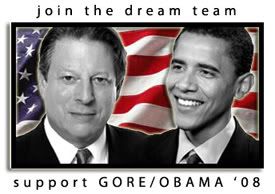
Mahoney suggested that Democrats could get behind either a Gore/ Clinton or Gore/ Obama ticket. From Gore's point of view, a Gore/ Obama scenario is far more likely as he doesn't get along with the Clintons well anymore, and seems to have more in common with Obama.

Okay, so this probably (definitely) isn't going to happen. But, it raises a good opportunity to talk about the person most qualified to be the next president-- the man that combines Hillary's experience (only not fabricated) and Obama's judgment (only more specific).

Gore is always the smartest person in the room, and he knows it-- and that's always been his biggest problem. Back in 2000, when he rolled his eyes every time George Bush attempted to answer a question, it was the genuine reaction of a guy a foot smarter than his opponent.

A couple of days ago, I posted the speech Barack Obama gave a week before the authorization to invade Iraq. Now, it's time to rehash Gore's. Their conclusions are identical, but the speeches, like the men themselves, are very different.

Where Obama's is short and to the point, Gore's is long and methodical. Obama's is soaring and inspiring, and almost poetic in its delivery. Gore is scientific as he breaks down, point by point, why the war is the wrong decision. It's like a law review article in his precision, perhaps one drafted by Holmes.

Quick reminder: the speech was given on Sept. 23, 2002. At the time President Bush's approval ratings were in the upper 60s, and Al Gore had yet to publicly criticize any move by the president since their divisive 2000 election.

It's long, so here's the link to the transcript, and below are some key excepts.

Contrasting the first Gulf War (which he vigorously supported) with the present proposed action:

... Fifth, President George H. W. Bush purposely waited until after the mid-term elections of 1990 to push for a vote at the beginning of the new Congress in January of 1991. President George W. Bush, by contrast, is pushing for a vote in this Congress immediately before the election. Rather than making efforts to dispel concern at home an abroad about the role of politics in the timing of his policy, the President is publicly taunting Democrats with the political consequences of a "no" vote - even as the Republican National Committee runs pre-packaged advertising based on the same theme -- in keeping with the political strategy clearly described in a White House aide's misplaced computer disk, which advised Republican operatives that their principal game plan for success in the election a few weeks away was to "focus on the war." Vice President Cheney, meanwhile indignantly described suggestions of political motivation "reprehensible." The following week he took his discussion of war strategy to the Rush Limbaugh show.

On preemptive war
:

By shifting from his early focus after September 11th on war against terrorism to war against Iraq, the President has manifestly disposed of the sympathy, good will and solidarity compiled by America and transformed it into a sense of deep misgiving and even hostility. In just one year, the President has somehow squandered the international outpouring of sympathy, goodwill and solidarity that followed the attacks of September 11th and converted it into anger and apprehension aimed much more at the United States than at the terrorist network - much as we manage to squander in one year's time the largest budget surpluses in history and convert them into massive fiscal deficits. He has compounded this by asserting a new doctrine - of preemption.

Iraq after invasion:

... Moreover, if we quickly succeed in a war against the weakened and depleted fourth rate military of Iraq and then quickly abandon that nation as President Bush has abandoned Afghanistan after quickly defeating a fifth rate military there, the resulting chaos could easily pose a far greater danger to the United States than we presently face from Saddam.

... When Secretary Rumsfield was asked recently about what our responsibility for restabilizing Iraq would be in an aftermath of an invasion, he said, "that's for the Iraqis to come together and decide."

Concluding:

... What this doctrine does is to destroy the goal of a world in which states consider themselves subject to law, particularly in the matter of standards for the use of violence against each other. That concept would be displaced by the notion that there is no law but the discretion of the President of the United States.

I believe that we can effectively defend ourselves abroad and at home without dimming our principles. Indeed, I believe that our success in defending ourselves depends precisely on not giving up what we stand for.

Friday, March 21, 2008

Richardson Gives Stirring Endorsement

New Mexico governor Bill Richardson, longtime Clinton compatriot, endorsed Hillary Clinton's Democratic rival, Barack Obama, today. This is surprising for at least two reasons: Richardson owes a lot of loyalty to the Clintons for two high level administration appointments (UN ambassador and Secretary of Energy) and he probably would have been at the top of Hillary Clinton's list for vice presidents. Although with Obama's lead, that possibility seems vanished (a Clinton/ Obama ticket is the best she can hope for).


In part two, Richardson gives an interesting story from the campaign trail that he says illustrates why Obama is a genuinely "good guy."


Richardson is the second former Democratic presidential candidate to endorse Sen. Obama, joining Connecticut Senator Chris Dodd.

Monday, March 10, 2008

Pictures of the Day 3/10: The Deciders


Superdelegates could play a huge role in deciding the Democratic nomination. Most superdelegates are elected officials, governors, congressmen, etc. However, others are somewhat less distinguished. Certain members of College Democrats and Young Democrats for America also hold the title of "Superdelegate," and thanks to Gawker.com we've got some of their embarrassing Facebook pictures.